Problem
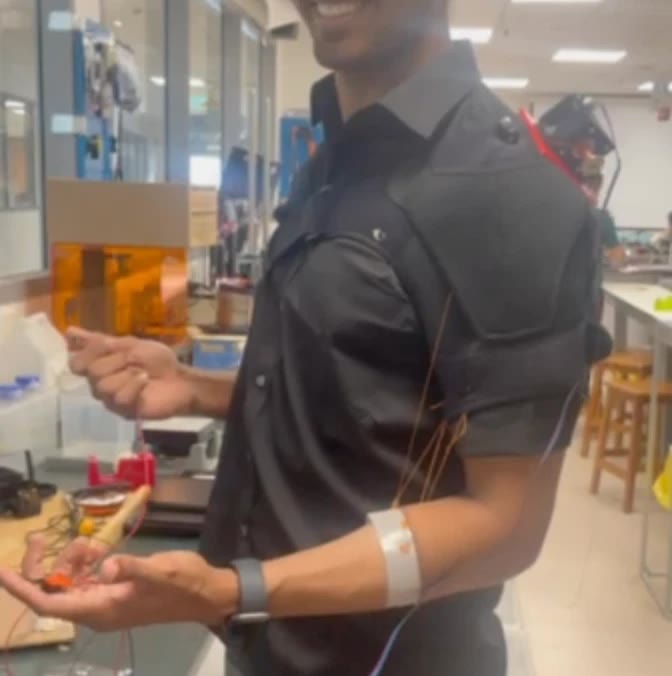
People with weak arm muscles, from muscular dystrophy, an injury or simply carrying a child all day, can use powered arm supports. Most are bulky, heavy and obvious. We wanted something a person could wear under a jacket without anyone noticing, that helps with one movement: bending the elbow.
The closest reference was ETH Zurich's Myoshirt, a textile exomuscle with a motor-driven cable that assists the shoulder. Its off-body actuator and control box weighs about 4 kg. We went smaller and simpler: one joint, hobby-grade parts, everything in a bag.
How it works
- A handheld joystick tells an Arduino UNO to step a NEMA 17 motor. A software step count limits travel, the default state is off, and a kill switch cuts the supply.
- The motor sits on a plate over a padded shoulder brace and turns a 3D-printed spool, which winds in fishing line.
- The line comes over the shoulder and down the front of the arm to a band set above the biceps. Lower down, it slipped.
- Between that band and a forearm band, the line runs back and forth through sewn-on steel hook-and-eye fasteners, about four strands, and is tied off.
- Winding shortens every strand at once. The forearm band is pulled toward the upper band, and the forearm swings up about the elbow, the way the biceps pulls. Unwinding lets the arm lower under its own weight.
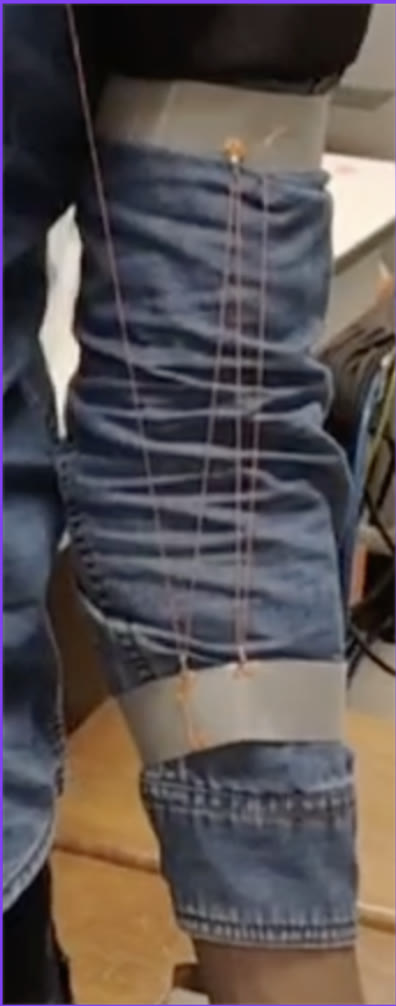
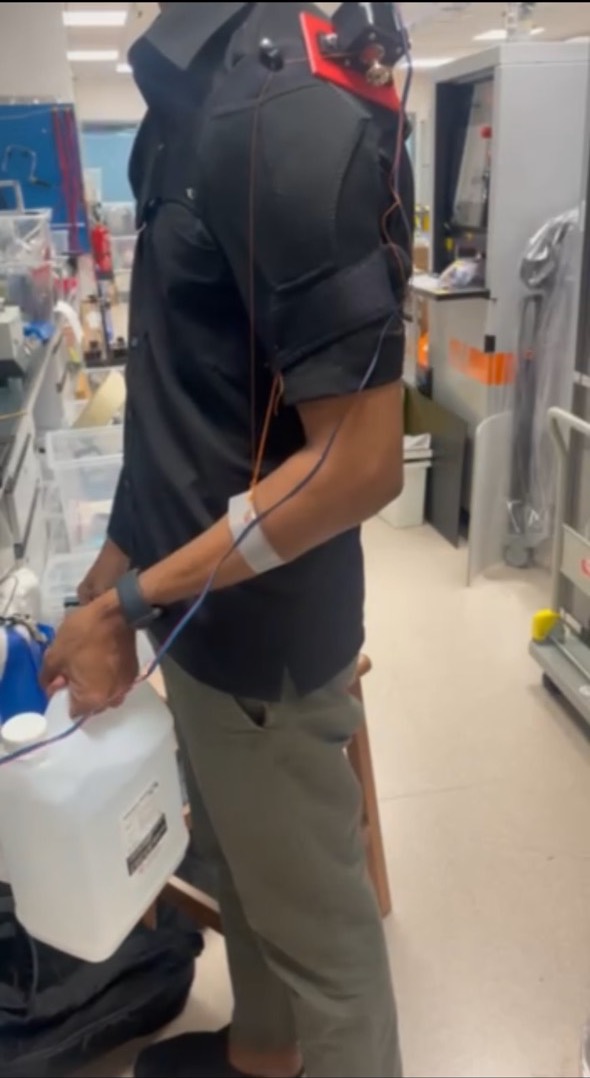
The hooks replaced 3D-printed pulleys with bearings. We chose them because they are hardened steel, smooth enough to act like a bearing, light, easy to sew on and strong. Ten iterations got us there: finger cables, a glove harness, cloth straps, a shoulder-strap platform, bearing pulleys, then hooks, the stepper, a back-mounted base plate and an undersleeve for comfort.
What the forces say
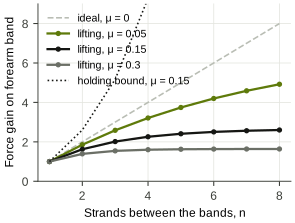
We never instrumented the prototype, so I built a quasi-static model of the elbow with the same hook geometry as the 3D model, standard segment masses for a 70 kg adult and capstan friction at every hook. Every parameter is an estimate, and the code is open. Three findings stand out.
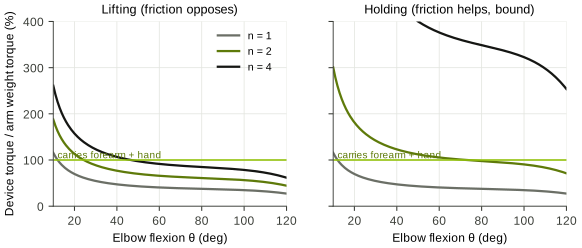
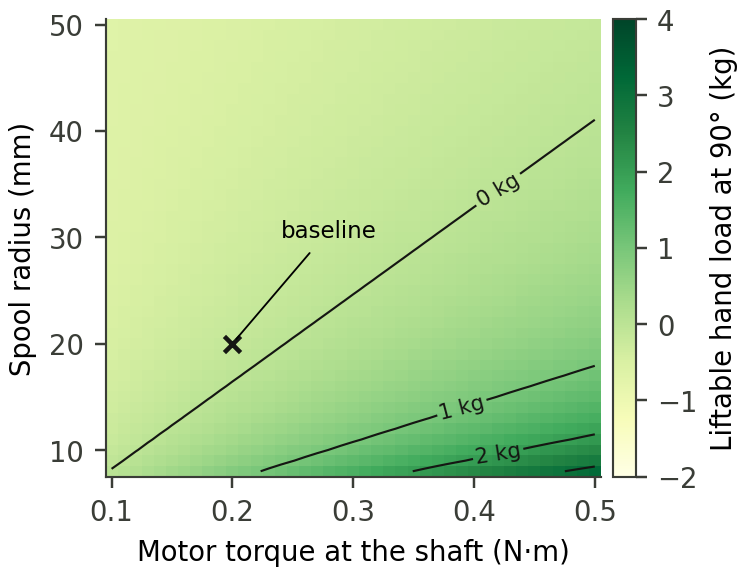
One more correction. Our slides once claimed a 20.3 kg lifting capacity. The formula on that slide actually evaluates to 2.04 kg. It also assumed a gearbox we rejected and gave force at the spool, not at the hand. We withdrew the figure.
Demonstrations
Videos have no sound and play only when you press play.
What we showed, and what we did not
| Claim | Status |
|---|---|
| Raises and lowers the forearm by joystick | Shown on video |
| Works while holding a jerrycan | Shown; jerrycan mass unknown |
| Can be worn under a jacket with the electronics in a bag | Shown in a team test; no observer study |
| Force needed to lift the arm holding an object | 7.6 kg peak on a luggage scale (team reading). This is the demand on an assist, not what the device produced |
| User feedback | One volunteer, one session: the arm moved; she was surprised it carried the jug but said it did not feel strong. The two-button control confused her, so we switched to a joystick |
| Assist force, efficiency, muscle activity | Not measured |
| System mass | Target under 3 kg; never weighed |
This is a course prototype, not a medical device, and we make no claim of clinical benefit or novelty. The paper sets out a bench rig and a small user study that would turn the model's predictions into measurements.
Team and credits
- Sreeram VasanthTeam lead. Market research and roadmap, spool and coupler design, the hook-and-line arm arrangement and its anchoring, kill switch, hardware, wiring and housing. Force model and working paper.
- Liau Kheng Wee BryanHardware. Printed mounts, housings and pulley-system iterations, safety.
- Dai JingyangElectronics. Stepper driver wiring, Arduino code, step limit, Bluetooth to motor.
- Shreya JindalProcurement and budget, Bluetooth app, sensor research.
- Sarah Tan Jun LeCommunications and team blog, usability session.
- Dr HoSupervisor.
Thanks to Prof Andy, Han Yang, Jeremy and Dr Ho for their guidance, to Justin of SG Enable for talking us through what users need, and to the volunteer who tried it on.
In memory of Mr Tony, our lab manager, who helped us more than he had to.
Read more
- Working paper (PDF): design, force model, seven charts, limitations and a test plan.
- GitHub repository: model code, figures, the 3D model and the paper source.
- Team blog (2024): the original build log.